Determinants of Southeast Asia’s Future: Neighborhood Peace, Neutrality-Plus Agency, and Networked Diplomacy | Kuik Cheng-Chwee
วันที่นำเข้าข้อมูล 5 Nov 2026
วันที่ปรับปรุงข้อมูล 5 Nov 2026
No. 6/2026 | November 2026
Determinants of Southeast Asia’s Future: Neighborhood Peace, Neutrality-Plus Agency, and Networked Diplomacy
Kuik Cheng-Chwee*
(Download .pdf below)
Three factors will shape Southeast Asia’s future and determine whether ASEAN can weather the ongoing polycrisis amid intensifying great-power rivalry and deepening global uncertainty. The first is neighborhood peace and stability: the extent to which states in both mainland and maritime Southeast Asia can manage relations with their immediate neighbors peacefully, preventing bilateral disputes or subregional tensions from escalating and undermining regional stability and prosperity. The second is neutrality-plus agency: the extent to which Southeast Asian states are able to continue pursuing a policy of not taking sides between the United States and China, and to do so actively, inclusively, and adaptively rather than passively. The third is networked middle-power diplomacy: the extent to which ASEAN states can seize the current moment of global realignment, as the next-tier powers and other secondary states across regions recalibrate their external postures and cultivate wider networks of survival-driven partnerships in response to unprecedented uncertainty.
Each factor concerns a distinct set of relationships: the first, relations within Southeast Asia; the second, relations with the competing superpowers; and the third, relations with middle powers and other smaller states in Asia and beyond.
- Neighborhood Peace and Stability (and Thailand’s Unique Role)
As the saying goes, you can choose your friends, but you cannot choose your neighbors, and this holds even more true among states. In Southeast Asia, neighborhood is a more useful unit of analysis than broader terms such as “region” or “community” for explaining the factors and fundamentals that underpin relations between sovereign states. This is largely because the ASEAN region comprises not one but two neighborhoods, mainland and maritime Southeast Asia, each with its own distinct historical, socio-political, and developmental complexities.
Peace in mainland Southeast Asia was undermined in 2025, when armed conflict erupted between Cambodia and Thailand over border crisis. Two major rounds of fighting shattered more than a decade of relative stability between the two countries. Although large-scale combat has paused, tensions remain high and many people are still displaced.
Maritime Southeast Asia, by contrast, remains stable, with low possibility of armed conflict among ASEAN’s founding members. Yet this peace should not be taken for granted. ASEAN was established in August 1967 in the wake of Konfrontasi, a low-intensity conflict from 1963 to 1966 that involved or affected Indonesia, Malaysia (which then included Singapore, until its separation in 1965), and Brunei. A central raison d’être of ASEAN was to prevent a recurrence of Konfrontasi-type conflict in the region. The absence of armed conflict among the founding members since then does not mean they are free of unresolved territorial or other bilateral disputes. The Cambodia–Thailand conflict is a stark reminder that neighborly relations can be fragile, and that shelved disagreements can resurface to disrupt the peace.
Without neighborhood peace, there can be no sustainable regional stability, and without regional stability, the countries of Southeast Asia and the ASEAN Community cannot prosper. Thailand, as a country that bridges the two neighborhoods and among the ASEAN key members linking the region with partners beyond it, has long played an instrumental role in sustaining regional stability and prosperity. In the aftermath of Konfrontasi, Bangkok provided good offices that helped bring maritime Southeast Asian states together to establish ASEAN. Alongside fellow members and partners, Thailand also contributed to ASEAN’s enlargement from six to ten members in the 1990s and to the institutionalization of ASEAN-based regional mechanisms such as the Chiang Mai Initiative (CMI) in 2000 and its multilateralized successor (CMIM) in 2010. Today, however, Thailand finds itself mired in a confrontational bilateral dispute. The sooner this neighborly dispute is resolved, the brighter the prospects for regional stability, and the greater the room for prosperity-seeking cooperation, not only among Southeast Asian states but also with regional partners near and far, big and small.
- Neutrality-Plus Agency: An Active, Adaptive Art of Small-State Survival
Owing largely to its strategic location and rich natural resources, Southeast Asia has long been, and remains, an epicenter of major-power competition. As weaker states, ASEAN members know full well that they can neither stop the major powers from competing nor insulate themselves from the consequences of that competition. For the sake of survival, most ASEAN states have therefore pursued a policy of neutrality, aiming to reduce the risk of entrapment in great-power conflicts while avoiding needless estrangement from any of the competing powers.
Neutrality, understood as not siding with any major power, is a sine qua non for Southeast Asia’s present-day stability and for ASEAN states’ ability to exercise agency. If some or most states abandon their longstanding neutrality and begin siding with one power against another, Southeast Asia’s future will be bleak. And if any states begin acting as proxies for a major power, ASEAN as a group will have no future at all. Southeast Asia’s future would then become its past: the conflict-prone region of the Cold War, when rival extra-regional powers backed and armed regional states as proxies, sparking hot wars, fueling fears of falling dominoes, and turning the region into a battlefield for global ideological and power rivalries.
Neutrality can take many forms: passive or active, isolationist or inclusive, rigid or adaptive. With U.S.-China rivalry intensifying during Donald Trump’s second presidency, competition over Southeast Asia is likely to grow fiercer. ASEAN states must therefore hold firm to their longstanding neutrality, even as the Philippines and Thailand maintain their alliances with the United States (which need not entail taking sides in U.S.-China rivalry); and they must pursue it proactively, pragmatically, and prudently, both individually and collectively.
This approach can be called “neutrality-plus” agency. The “plus” lies in pursuing neutrality in an inclusive, active, and adaptive manner: inclusively, by diversifying developmental and strategic partnerships; actively, by signaling a clear stance of not taking sides; and adaptively, by recalibrating policy tools as conditions change in an increasingly fluid and complex geopolitical landscape.
Not taking sides is not the same as not taking positions. ASEAN states have taken, and must continue to take, positions on major issues on the basis of principled pragmatism. These include affirming that the sovereignty and territorial integrity of all states, big and small, must be respected; upholding the principle of coexistence and co-survival; and supporting mutually beneficial dialogue and cooperation.
Neutrality-plus is no panacea. It cannot stop the major powers from applying pressure, it guarantees no particular outcome, and it does not make any state immune to external challenges. What it does is reduce the twin risks of entrapment and estrangement. In addition, it avoids the dependence on a single patron that leaves a state exposed to abandonment, and it averts the dangers of subservience abroad and eroding legitimacy at home. At the same time, it preserves autonomy and cultivates options: maximizing cooperation, maintaining room for maneuver, keeping channels of communication open, and expanding layers of productive partnership, even as geopolitical volatility narrows the space in which to do so. In short, neutrality-plus enables Southeast Asian states to live with growing uncertainty while still leveraging on emerging opportunities and limiting risks.
- Networked Diplomacy: Leveraging the Emerging Middle-Power Realignment
The present era is shaped not only by growing rivalry among the major powers but also by an evolving middle-power realignment. This realignment does not mean switching loyalty from one superpower to another, nor middle powers forming a bloc of their own to challenge the major powers. Rather, it is an ongoing process of converging self-help efforts. A growing number of non-great powers, feeling exposed to the unpredictable action and reaction between the superpowers, see more reason to work together and build new partnerships despite their differences. Earlier waves of middle-power diplomacy during the Cold War and immediate post-Cold War era were driven mainly by shared values among Global North countries, most of them closely tied to the United States. Today’s middle-power moment is driven mainly by shared vulnerabilities, regardless of political system or level of development. It involves not only Global North countries, mostly U.S. allies in Europe, Northeast Asia, Australasia, and Canada, but also large and emerging economies across the Global South.
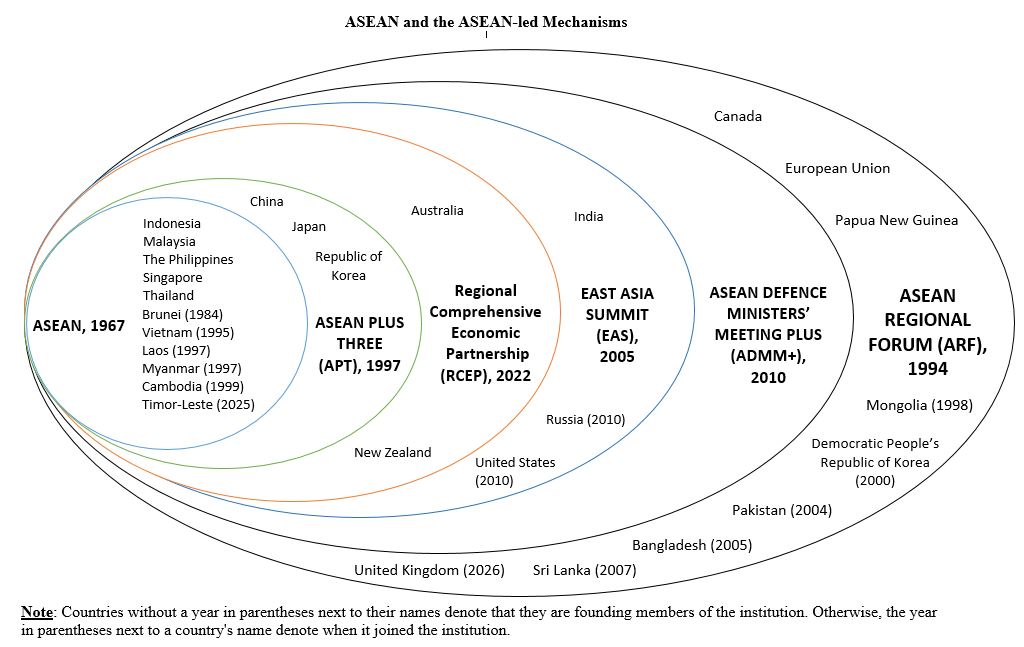
Southeast Asia and ASEAN should seize this trend to extend their network diplomacy beyond the existing circles of ASEAN-led mechanisms (see Figure 1), building more layers of partnership in development, diplomacy, and defense. The wider these circles and the more productive these partnerships, the brighter Southeast Asia’s future.
As major and middle powers compete to cooperate, Southeast Asia can turn shared vulnerabilities into shared pragmatism, managing common challenges and pooling capabilities and resources. As a center of courtship, ASEAN is well placed to do this in three ways:
- Bridging the gaps in perception and policy between two types of middle powers: the alliance-centric (mostly in the Global North) and the alliance-allergic (mostly in the Global South). Middle powers with different strategic DNA need to work together to manage expectations, avoid unrealistic demands, and prevent rival alignment clusters that would make middle-power diplomacy part of the problem rather than the solution.
- Boosting existing cooperation with partners across levels and domains, through ASEAN-led and ASEAN-centered institutions such as the ASEAN Defence Ministers’ Meeting (ADMM)-Plus and Regional Comprehensive Economic Partnership (RCEP), as well as the Comprehensive and Progressive Agreement for Trans-Pacific Partnership (CPTPP) and the Digital Economy Partnership Agreement (DEPA). Concrete results would show that middle powers from different regions and levels of development can work together even when they are not like-minded.
- Building new partnerships across sectors on complementary foundations, proving the practical case that countries with shared vulnerabilities gain from working together.
This is not wishful thinking. ASEAN-wide and ASEAN-plus institutions are quietly but steadily becoming platforms for resilience, for ASEAN members and partners alike. In July 2026, ASEAN made Türkiye its twelfth dialogue partner, and its first from the Middle East, while granting Germany and Qatar sectoral dialogue partner status. That same month, the ASEAN Regional Forum (ARF) admitted the United Kingdom as its 28th participant, an exception to its moratorium. Canada and the EU have long sought seats at the East Asia Summit (EAS) and the ADMM-Plus; Canada’s EAS bid dates back to at least 2017. In September 2026, RCEP ministers set up a working group to review membership applications from Bangladesh, Chile, Sri Lanka, and Hong Kong. Cross-regional links are also growing: the CPTPP held its first trade and investment dialogues with ASEAN and with the EU in November 2025, and in June 2026 began preparatory accession talks with the United Arab Emirates, the Philippines, and Indonesia.
Conclusions
In conclusion, the three factors reinforce one another. Lasting neighborhood peace supports regional stability and ASEAN unity, and it also makes Southeast Asian neutrality more credible and ASEAN’s network diplomacy stronger. Neutrality-plus, in turn, keeps ASEAN a trusted convener for partners of every alignment, while a wider network of partnerships gives ASEAN states more options, making neutrality easier to sustain. This matters all the more as non-great powers everywhere are adding partners, not to replace existing ones but to supplement them, so as to widen their options and strengthen their capabilities.
[*] Professor of International Relations at the Institute of Malaysian and International Studies (IKMAS), National University of Malaysia (UKM).